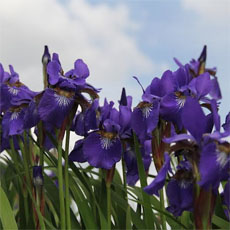
Tall Bearded Iris 'Honky Tonk Blues'

Iris

Family
Iridaceae (eye-rid-AY-see-ee)
Genus
Iris (EYE-ris)
Synonym
Hybridized
Schreiner
Registered or introduced
1988
Height
36-48 in. (90-120 cm)
Spacing
12-15 in. (30-38 cm)
15-18 in. (38-45 cm)
18-24 in. (45-60 cm)
Hardiness
USDA Zone 3a: to -39.9 °C (-40 °F)
USDA Zone 3b: to -37.2 °C (-35 °F)
USDA Zone 4a: to -34.4 °C (-30 °F)
USDA Zone 4b: to -31.6 °C (-25 °F)
USDA Zone 5a: to -28.8 °C (-20 °F)
USDA Zone 5b: to -26.1 °C (-15 °F)
USDA Zone 6a: to -23.3 °C (-10 °F)
USDA Zone 6b: to -20.5 °C (-5 °F)
USDA Zone 7a: to -17.7 °C (0 °F)
USDA Zone 7b: to -14.9 °C (5 °F)
USDA Zone 8a: to -12.2 °C (10 °F)
USDA Zone 8b: to -9.4 °C (15 °F)
Sun Exposure
Full Sun
Danger
Parts of plant are poisonous if ingested
Handling plant may cause skin irritation or allergic reaction
Bloom Color
Dark Blue
Foliage
Herbaceous
Class
Tall Bearded (TB)
Bloom Time
Midseason (M)
Bloom Time
Bloom Time
Bloom Color
Bloom Time
Bloom Color
Bloom Color
Bloom Time
Other Details
Other details
Propagation Methods
By dividing rhizomes, tubers, corms or bulbs (including offsets)
Seed Collecting
N/A: plant does not set seed, flowers are sterile, or plants will not come true from seed
Soil pH requirements
6.1 to 6.5 (mildly acidic)
6.6 to 7.5 (neutral)
7.6 to 7.8 (mildly alkaline)
Patent Information
Non-patented
Awards (if applicable)
Honorable Mention
Award of Merit
Dykes Memorial Medal
John C. Wister Memorial Medal (TB)
Foliage Color
Bloom Characteristics
Water Requirements
Average Water Needs; Water regularly; do not overwater
Where to Grow
Fruit Shape
Fruit Size
Fruit Colors
Growing Habit
Days to Maturity
Seed Type
Disease Resistance
Leaf Type
Plant Size (check one)
Growing Habit
Growth Rate
Leaf Shape
Leaf Appearance
Degree to which the appearance is present
Leaf Texture (top)
Leaf Texture (bottom)
Leaf Color
Color of Leaf Margin
Leaf Substance
Number of Vein Pairs
Appearance of Margin
Margin Width
Flower Shape
Flower Fragrance
Does it set seed?
Flower Size
Flower Type
Blooming Habit
Foliage Habit
Color Patterns
Awards (if applicable)
Seed Type
Growth Habit
Days to Maturity
Bloom Shape
Other Details
Pruning Instructions
Kernel Color
Flower Shape
Flower Habit
Bloom Size
Color Pattern
Bloom Shape
Pruning Groups
Bloom Diameter
Heat (Pungency)
Fruit Shape
Fruit Size
Fruit Color
Disease Resistance
Seed Type
Flower Size
Size/Type
Flower Characteristics
Leaf Shape/Type
Leaf Texture
Leaf Color
Propagation
Pollination
Bearing Habit
Rootstock Vigor
Disease Resistance
Fruit Usage
Classification
Regional

This plant is said to grow outdoors in the following regions:

Durham, Maine

Belleville, Michigan

Blanchard, Michigan

Alton, Missouri

Robertsville, Missouri

Las Cruces, New Mexico

Los Alamos, New Mexico

Milan, Ohio

Bartlesville, Oklahoma

Lawton, Oklahoma

Ponca City, Oklahoma

Rapid City, South Dakota

Greeneville, Tennessee

Readyville, Tennessee

Sweetwater, Tennessee

Tyler, Texas

Rosalia, Washington

show all

Featured Videos

Gardener's Notes:

3
positives
2
neutrals
0
negative
Sort By:
Sort By:
E
Las Cruces, NM (Zone 8a) | May 2016 | positive

The blue on this flower is a very good medium blue. I planted last fall and it put out multiple beautiful blooms this Spring. Also, som...Read More

M
M
Durham, ME (Zone 3a) | January 2009 | positive

Very hardy in my zone and it does have purple base fans.

J
J
Belfield, ND (Zone 4a) | May 2007 | neutral

Awards: Honorable Mention 1990; Award of Merit 1992; Wister 1994; Dyke's Medal 1995

D
D
Stanford, CA (Zone 9b) | March 2005 | neutral

'Honkey Tonk Blues' is a 37" mid-season bloomer. Highly recognized, it has won the American Iris Society Honorable Mention '90; Award of...Read More

N
Ponca City, OK | June 2003 | positive

This is an odd thing. Has splashes of near white on a mid blue flower. Exactly how it looks depends on your soil and the weather. Grow...Read More

Featured
Standard Dwarf Bearded Iris 'California Boy'
(Pantydia sparsa)
Broad-winged Hawk
(Buteo platypterus)
Featured
Standard Dwarf Bearded Iris 'California Boy'
(Pantydia sparsa)
Broad-winged Hawk
(Buteo platypterus)